Quantum Computing Complete Guide — From Qubits to the NISQ Era
양자 컴퓨팅 완전 가이드 — 큐비트부터 NISQ 시대까지
A classical bit is always 0 or 1. A qubit exists in superposition until measurement; entanglement and interference let algorithms cancel wrong paths and amplify correct ones. This post is a reference guide to quantum computing—core concepts in one infographic, plus gates, algorithms, applications, and today’s limits.
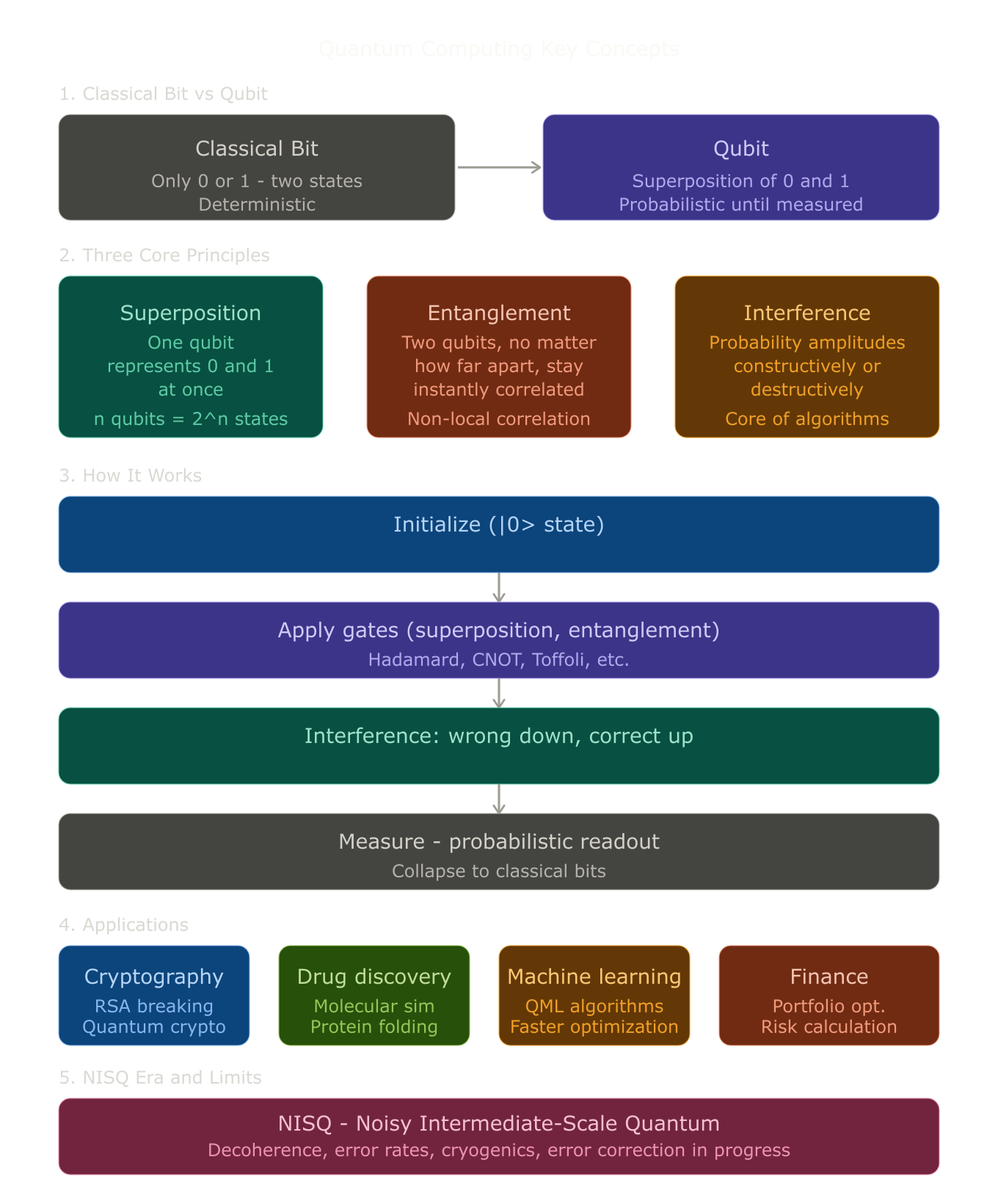
01 · Classical bit vs qubit
| Classical bit | Qubit | |
|---|---|---|
| State | 0 or 1 (definite) | α|0⟩ + β|1⟩ (superposition, |α|²+|β|²=1) |
| Nature | Deterministic | Probabilistic — collapses on measurement |
| Copying | Allowed | Forbidden (no-cloning theorem) |
| Parallelism | n bits → n values | n qubits → 2ⁿ states at once |
Classical bits map to transistor voltage levels and do not change when read. Qubits are built from superconductors, ion traps, photons, electron spin, and more; the same circuit can yield different outcomes across runs.
02 · Three pillars of quantum mechanics
Superposition
One qubit represents 0 and 1 at once. A Hadamard gate turns |0⟩ into (|0⟩+|1⟩)/√2; n qubits can encode 2ⁿ states in principle. Measurement collapses the wavefunction to one outcome with a given probability.
Entanglement
Two qubits share a single quantum state. In a Bell state such as (|00⟩+|11⟩)/√2, measuring one qubit instantly fixes the other—Einstein’s “spooky action at a distance,” confirmed by Bell tests. It does not allow faster-than-light messaging; only non-local correlation.
Interference
Probability amplitudes add like waves, constructively or destructively. Algorithm design hinges on tuning phase so correct paths amplify and wrong paths cancel—what separates quantum from classical computation.
03 · How a quantum computer runs
- Initialize — Reset qubits to |0⟩. Superconducting devices often run near ~15 mK, colder than the cosmic microwave background.
- Apply gates — Build circuits with Hadamard (superposition), CNOT (entanglement), T/S/Z (phase), Toffoli (universal classical logic), and more.
- Control interference — Shape phases so desired outputs gain amplitude and others fade.
- Measure — Superposition collapses to 0 or 1. Algorithms are run many times to estimate outcome statistics.
04 · Key quantum gates
| Gate | Role |
|---|---|
| H (Hadamard) | |0⟩ → equal superposition |
| CNOT | Flip target when control is |1⟩; core 2-qubit gate for entanglement |
| T · S · Z | Phase rotations by π/4, π/2, π; fine interference control |
| Toffoli (CCNOT) | Flip target when both controls are |1⟩; universal classical logic |
05 · Major quantum algorithms
| Algorithm | Problem | Speed / note |
|---|---|---|
| Shor (1994) | Integer factorization | Exponential → polynomial time; threatens RSA/ECC; drives post-quantum crypto (PQC) |
| Grover (1996) | Unstructured search | O(N) → O(√N); quadratic speedup, many practical uses |
| VQE | Molecular ground energy | Hybrid quantum–classical; NISQ-friendly; drug and materials science |
| QAOA | Combinatorial optimization | Approximate solutions to NP-hard problems; logistics, portfolios |
| HHL (2009) | Linear system Ax=b | Conditional exponential speedup; QML and simulation; I/O overhead debated |
| Quantum teleportation | State transfer | Entanglement + classical channel; QKD and quantum internet protocols |
06 · Application areas
| Area | Focus |
|---|---|
| Cryptography | Shor threatens public-key schemes · QKD for eavesdrop-proof channels · PQC migration |
| Drugs & materials | Molecular and protein-folding simulation; caffeine (C₈H₁₀N₄O₂) needs ~10⁴⁸ classical variables |
| Finance & optimization | Portfolios, risk, scheduling; PoCs at JPMorgan, Goldman Sachs, IBM Q Network |
| Quantum ML | VQCs, quantum kernels, HHL-based regression; TensorFlow Quantum, PennyLane; still early |
07 · The NISQ era and its limits
NISQ (Noisy Intermediate-Scale Quantum) describes today’s noisy, mid-size devices.
| Metric | Status (~2025) |
|---|---|
| Physical qubits | 1,000+ (e.g. IBM Condor 1121q) |
| Fault-tolerant QC | ~10⁶ physical qubits per logical qubit (estimate) |
| Quantum supremacy | Google Sycamore ~200 s vs ~10,000 years classical (disputed) |
Main challenges
- Decoherence — Environment destroys quantum state; coherence often tens to hundreds of μs.
- High error rates — Two-qubit gates at 0.1–1%; practical work needs ≪0.001%.
- Cryogenics & scale — Superconductors near ~15 mK; more qubits mean control, crosstalk, and connectivity pain.
| Player | Notes |
|---|---|
| IBM | Eagle(127q) → Condor(1121q); 100k-qubit roadmap by 2033; Qiskit |
| Willow(105q, 2024); scaling with falling error rates | |
| IonQ | Ion trap, high fidelity |
| Korea | ETRI, national quantum-internet roadmap; Samsung, SK hynix on quantum memory |